Civic responsibility examples range from voting and volunteering to attending public meetings and serving on a jury. Voluntary actions can fit almost any schedule, while legal duties such as paying taxes and jury service are not optional.
Civic habits are largely learned, so the question of how does education affect society sits behind everything below. This guide explains what separates a duty from a responsibility, what participation changes in a community, and how to take a first step.
Duty, responsibility and the common good
Civic duties are legally required, and civic responsibilities are voluntary. The Office of the President of Dominica draws this line: civic duties include obeying the laws and paying the taxes the government levies, and civic responsibilities “are fulfilled by choice.” The same source says citizens who choose not to fulfil their civic duties face legal consequences. Serving on a jury or as a witness sits on the duty side of that line.
Responsibilities, by contrast, include registering to vote and voting, and serving on statutory boards and committees. Nobody is penalized for skipping them, which is why they depend on motivation and habit rather than enforcement.

A working definition from the civic education organization Civic Heart describes civic responsibility as active participation in the public life of a community in an informed, committed, and constructive manner, with a focus on the common good. Three qualities in that definition shape the examples that follow:
- Informed: an action counts for more when the person understands the issue behind it, which is why reading and discussion come before many of the other steps.
- Committed: a single gesture matters less than a repeated one, so recurring commitments such as a regular volunteer role tend to beat one-off acts.
- Constructive: the aim is a better shared outcome, not simply winning an argument at a meeting.
That explains why the voluntary side deserves attention. The Dominican source notes that a democratic society requires the active participation of its citizens in the affairs of the nation, and legal duties alone cannot supply that.
What participation changes in a community
Participation turns individual choices into shared results, and the available figures show both the scale of participation and the knowledge gaps around it. The Policy Circle’s civic engagement brief reports that approximately 64% of eligible voters cast a ballot in 2024. That figure describes a national election, so treat it as a baseline for how many people take part rather than a ceiling for any local contest.
The same brief states that research consistently shows people with higher levels of civic knowledge are more likely to vote. Knowledge is not evenly spread. A Purdue Global Law School guide cites an August 2020 Annenberg survey in which only 51% of adults could name all three branches of government correctly, and 23% could name none. It also reports that just 24% of eighth-graders were proficient on the 2018 National Assessment of Educational Progress civics test. For readers, the practical lesson is that learning how local institutions work is itself a civic act, and it makes every other action on this page more effective.
The community effects are visible at neighborhood level too. In 2023, 76% of U.S. adults reported being somewhat or very satisfied with their neighborhood, yet about 44% of Americans say they trust all or most of their neighbors. The brief also links access to shared civic spaces such as parks, libraries and community gathering places to stronger social ties, with limited access tied to weaker networks. Keeping those spaces used, funded and looked after is therefore a civic act in its own right, not a side project.
Civic responsibility examples and how to begin each
The table sorts common examples by whether they are required, so you can see which are obligations and which are choices.
| Action | Status | First step | Planning use |
|---|---|---|---|
| Obeying laws and paying taxes | Civic duty, legally required | Meet the obligation as it arises | Treat as a baseline, not an extra |
| Jury service | Duty; U.S. citizens aged 18 or older may be called | Respond when called | Plan work and family cover in advance |
| Voting | Voluntary but highly encouraged | Register to vote | Suits anyone who wants a direct say at low time cost |
| Serving on boards and committees | Voluntary responsibility | Find which statutory boards operate near you | Suits people ready for a longer commitment |
| Community meetings | Voluntary | Attend and listen | A low-pressure way to learn local issues |
| Volunteering and neighborhood groups | Voluntary | Pick a cause you care about | Flexible; scales from an event to a regular role |
The duty-versus-responsibility distinction comes from the Office of the President of Dominica, and the U.S. jury and voting details from USAHello’s civic responsibility guide.
Voting and helping others vote
Voting is the most familiar of the civic responsibility examples, and it is a choice. USAHello states plainly that you are not required to vote but it is highly encouraged. Registration is the step that makes everything else possible, so do it before you have a particular election in mind.
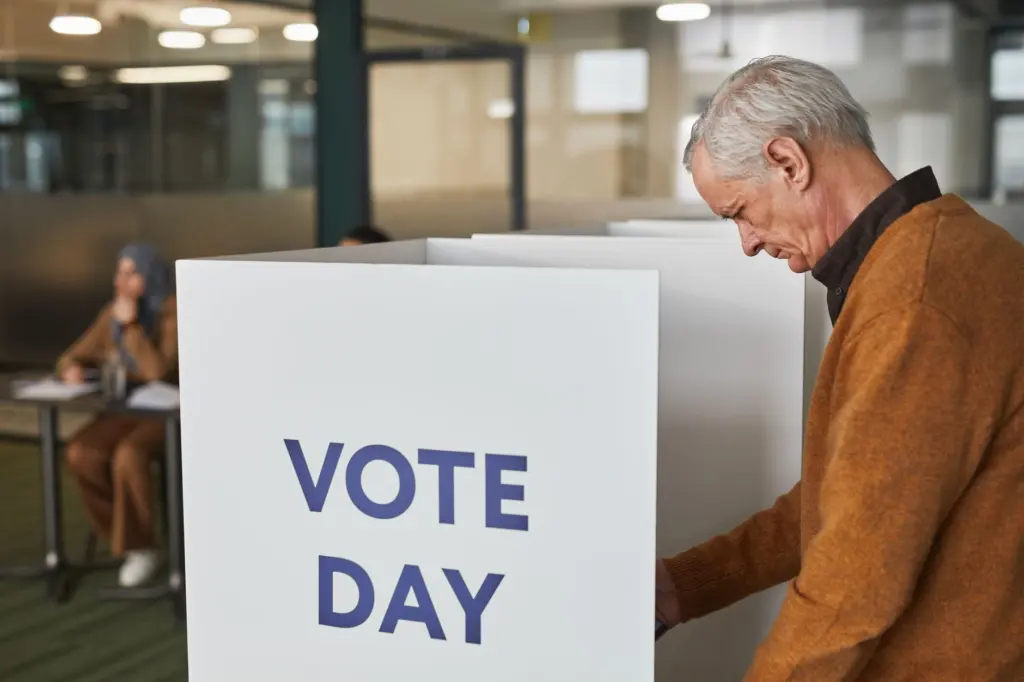
Voting is not the only political route. The Policy Circle brief also lists helping others register to vote, poll working and serving as an election judge. These suit people who want to go beyond casting their own ballot without standing for office.
Jury duty
Jury duty is the clearest case of a civic duty most adults may meet. In the United States, citizens aged 18 or older may be called to serve. Because the Dominican source places jury service among legally required duties, treat a call as an obligation to answer, not an offer to weigh up.
Public meetings
Attending a community meeting is a practical way to stay informed. USAHello recommends reading news from reliable sources, attending community meetings and discussing issues. A concrete case from the Policy Circle brief is an August 2021 forum in St. Charles, Missouri, which produced constructive dialogue between state transportation officials and over 100 community members. If you are new to this, go to listen first; the point of the first visit is to learn how decisions are discussed, not to make a speech.
Volunteering and neighborhood groups
The Policy Circle brief names volunteering with organizations that build community well-being, or taking part in community service projects, as a route into civic engagement. USAHello adds joining neighborhood groups and going to local events. Choose a cause you already care about; motivation matters more than the size of the commitment when nothing legally compels you to turn up. Cleaning a shared park is a good fit if you want visible results, since the brief ties access to parks and similar shared spaces to stronger social ties.
Community life also lives in culture, not only in meetings and ballots. Cultural Diversity In Everyday Life: 8 Practical Examples And Why They Matter In 2026 – Peopleil looks at how differences show up in ordinary neighborhoods, and American Wedding Traditions: Timeless Customs Shaping Modern Celebrations In 2026 – Peopleil covers one of the customs communities pass on.
Starting in stages
The simplest way to begin is to move from the lowest-effort action to the highest, stopping wherever your time runs out. Each stage builds knowledge that the next one uses.
- Get informed. Read news from reliable sources and discuss local issues with people around you.
- Register to vote. This is the entry requirement for the most widely recognized voluntary responsibility.
- Sit in on a community meeting. Listen to how issues are framed before deciding whether to speak.
- Choose a cause and volunteer. Match it to something you care about so you keep showing up.
- Join a neighborhood group. Groups and local events turn individual effort into shared effort.
- Consider a board, committee or poll-working role. These suit people ready for a longer-term responsibility.
Skip nothing in the required category while you work through these stages: the legal duties come first, and the voluntary ones are what turn a lawful resident into an active member of the community.
Frequently asked questions
What happens if someone ignores a civic duty?
Under the Dominican framework, citizens who choose not to fulfil their civic duties face legal consequences. Voluntary responsibilities carry no such penalty.
Is volunteering a duty or a responsibility?
It is a responsibility. It is chosen, so the common sources list it among voluntary ways to take part in the community.
Why does civic responsibility matter?
Democracy requires active participation by its citizens, and civic responsibility aims at the common good. Higher civic knowledge is also associated with more voting.
How can I start being civically active?
Begin with the lowest-effort step that suits you, such as registering to vote, reading reliable news or attending a community meeting. Then add a cause to volunteer for or a neighborhood group to join.